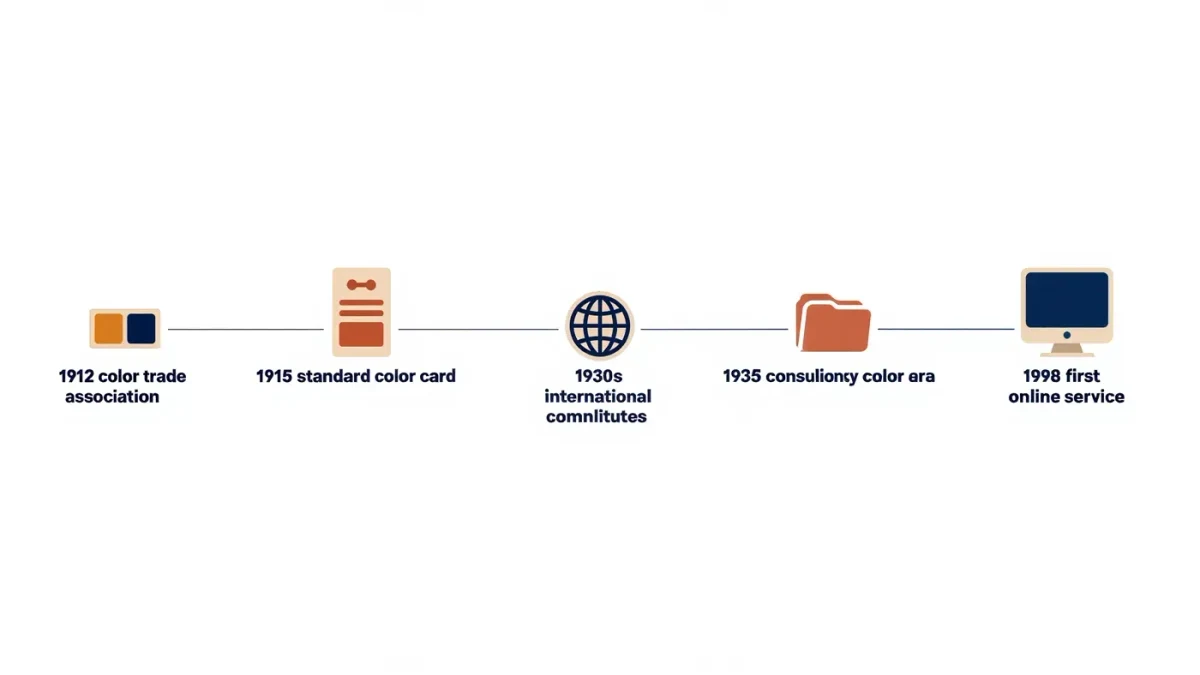
No single person invented trend forecasting. The profession assembled itself in pieces: American color trade bodies were standardizing palettes for manufacturers by the 1910s, European color committees were coordinating seasonal palettes across countries by the 1930s, and the full modern apparatus — mood boards, consumer archetypes, season-tagged reports — only came together after the Second World War. The earliest named institution is the Textile Color Card Association of the United States, founded in 1912 and led for decades by Margaret Hayden Rorke, which published the Standard Color Card of America in 1915 to give mills and garment makers a shared palette.
What those early color card publishers invented was the core transaction that still defines the industry: a small group studies signals across many trades, distills them into a documented palette or direction, and sells that judgment to producers who need to commit to cloth months before customers commit to purchases.
Where did the profession actually begin?
In standardization, not prophecy. The Textile Color Card Association was created because American mills, silk importers, and garment manufacturers were ordering colors with no common reference, and mismatches were expensive. Rorke's association polled trades, tracked what was selling in Paris and on American main streets, and issued cards that functioned as a shared language. Per the association's published history and accounts preserved in American trade-literature collections, its card guided both World War I military cloth and civilian fashion, which taught the industry that coordinated color could be managed commercially.
Europe organized along the same lines. By the 1930s, national color bodies were meeting internationally to agree on seasonal palettes years in advance — the cooperative structure that evolved into today's International Colour Authority — because yarn was spun, dyed, and woven on timelines that crossed borders. The wager of those committees was the founding insight of the profession: color and taste are not purely spontaneous, and a disciplined reading of the present can be turned into usable guidance about two seasons ahead.
When did forecasting become its own business?
After the war, as ready-to-wear replaced couture as the volume engine of fashion, the audience for guidance widened from mills to brands, retailers, and manufacturers of everything from hosiery to household goods. Independent consultancies emerged to serve them. The most consequential figure of this era is Li Edelkoort, who built her first forecasting practice within Dutch agencies in the 1970s and 1980s before founding Trend Union in Paris in the mid-1980s; her published seasonal books paired color with fabric, silhouette, and mood in a format the industry still recognizes, and her client list grew to include major European houses and brands across sectors.
Edelkoort's contribution was conceptual as much as commercial. In her framing, a forecast is not a prediction of hemlines but an argument about where culture is moving — she has described trends as signals already present in society, waiting to be made visible. That position turned forecasting from a clerical color service into an interpretive profession with a public voice.
Related stories: How a Season's Color Palette Is Built Two Years Ahead · What a Forecast Agency Actually Sells to Its Subscribers.
What did the first forecasters actually sell?
Confidence, in industrial quantities. A color card looks like a piece of paper, but what it removed was risk: a mill in Philadelphia and a dressmaker in Chicago could order cloth against the same documented swatches without correspondence, sampling, and guesswork. The committees' seasonal meetings added a second product — consensus. When national delegations agreed on a palette for a season two years out, every manufacturer at the table could plan dyestuffs, yarn purchases, and production capacity against it. That structure, documented in the trade press of the period, is why early forecasting centered on color rather than silhouette: color was the input shared by every textile trade, while cut and style still belonged to the couture houses and their copyists.
The economics explain the profession's endurance. Forecasting sits in front of the single most expensive decision in fashion — what to make before knowing what will sell — and any service that narrows that uncertainty, however imperfectly, has always found willing subscribers.
How did forecasting reach the internet age?
The defining disruption came in 1998, when WGSN was founded in London as an online forecasting service, delivering trend intelligence digitally rather than through printed reports and in-person presentations. The company's own account presents this as a step change: subscribers could read runway analysis and consumer research within days of the shows rather than weeks. Speed compressed the profession's cycle and widened its customer base beyond fashion into technology, food, beauty, and finance — industries that now routinely buy the same consumer foresight reports as apparel brands.
Today the lineage reads clearly. The color card of 1915, the interwar palette committees, the postwar consultancy, and the online platform are one continuous service evolving in format: filter the present, document the judgment, sell it to anyone whose production calendar outruns their certainty.
So who deserves the credit?
History gives it to an institution rather than a person. The Textile Color Card Association created the commercial mechanism in 1912; the interwar color committees made it international; Edelkoort made it interpretive; WGSN made it instant. If the question is who first sold organized foresight about taste, the answer is a committee of American tradesmen and Rorke's staff — a start few fashion histories bother to mention, and one the modern industry quietly depends on every season. The tools have changed beyond recognition; the transaction has not changed at all.